

Amman, Seven Hills and a Thousand Faces: A Journey to the Heart of the Jordanian Capital
14 août 2026 à 03h50 · GotaNomad · Mis à jour le 16 août 2026
A capital born twice
Amman is not a city that can be told in a single sweep. Under its ancient name of Rabbath Ammon, it was the capital of the Ammonites before becoming, under the Greeks, Philadelphia. Then, for centuries, the site was almost emptied of its population, visited only seasonally by Bedouin tribes such as the Bani Sakhr. It was in 1878 that everything began again: Circassian refugees from the Caucasus settled among the ruins of the ancient city, breathing new life into a place that had fallen into oblivion. It was not until 1921, with the arrival of Emir Abdullah, that Amman officially became a city and then the capital of the new Emirate of Transjordan. Since then, the city has continuously reinvented itself through successive waves of migration — Circassians, Chechens, and then Palestinian refugees in 1948, 1967 and 1991 — which have shaped a composite social fabric and a decidedly cosmopolitan identity.
The city of seven hills
Amman is said to be built on seven hills, each with its own character. Jabal Amman and its famous Rainbow Street bring together cafés, galleries and a lively nightlife. Jabal al-Weibdeh, a neighborhood built in the 1940s-1960s for the Palestinian middle class, has today become an artistic hub where contemporary galleries, a cultural institute and the Jordan National Gallery all coexist. Further toward the center, Downtown — or Al-Balad — remains the beating, popular heart of the capital, with its souks and narrow streets surrounding the Citadel and the Roman theater. On the opposite end, Abdoun is among the city's most prestigious districts, home to embassies and upscale residences, while Sweifieh and Shmeisani embody the modern Amman of business and shopping. This juxtaposition of worlds, within a fairly compact space, is undoubtedly what makes the city so fascinating to explore on foot.
Atop the Citadel, seven thousand years of history
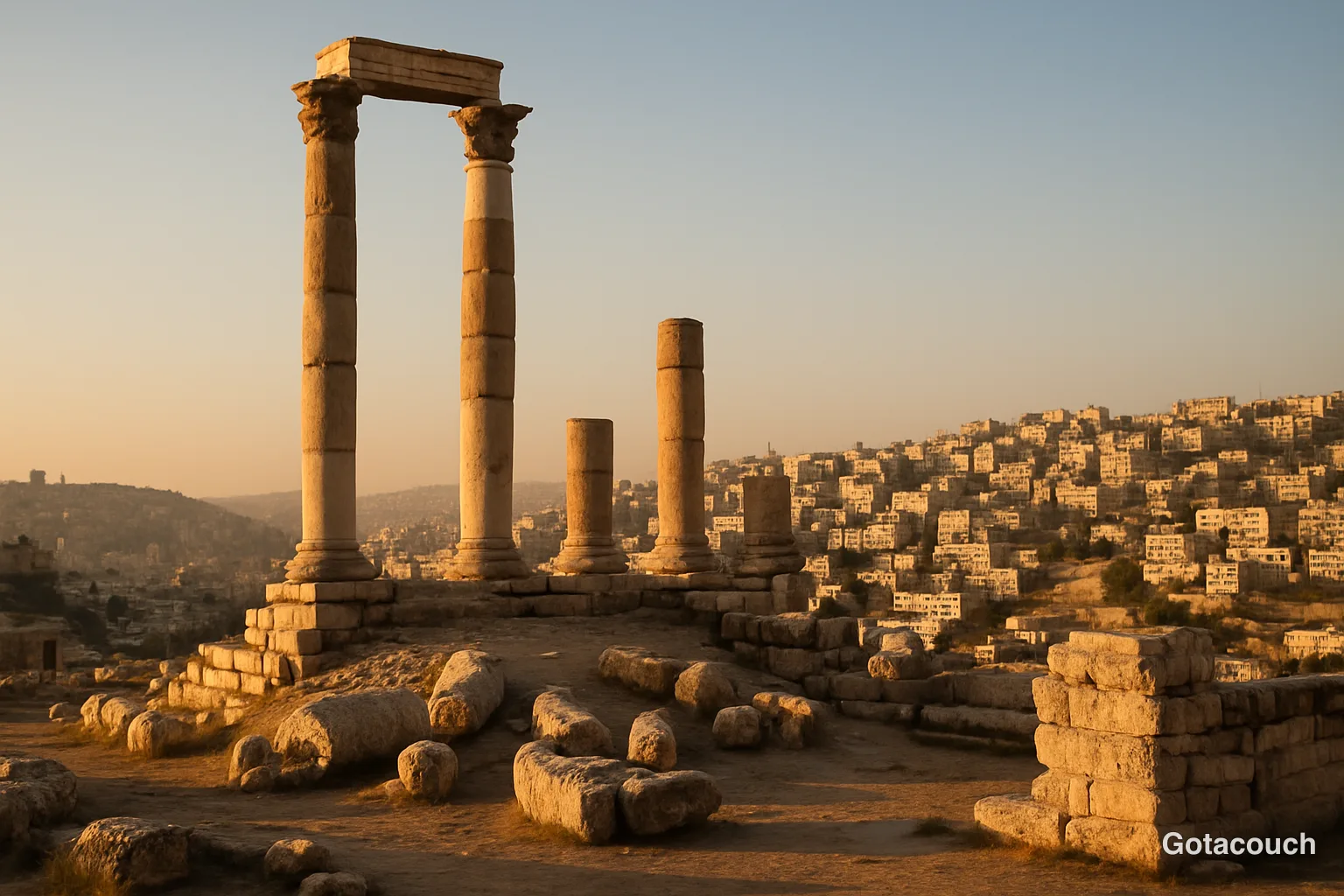
Perched at about 850 meters above sea level on the city's highest hill, the Citadel of Amman (Jabal al-Qal'a) is the site not to be missed. Visitors wander among remains spanning from the Bronze Age to the Islamic period, evidence of an almost uninterrupted occupation over thousands of years. The most photographed monument remains the Temple of Hercules, whose five 2nd-century AD Corinthian columns stand out against the sky: at their base lies a colossal stone hand, the only preserved fragment of the giant statue that once adorned the building. Not far away, the 8th-century Umayyad Palace, considered one of the best-preserved examples of this architectural style in Jordan, reveals its grand vaulted reception hall. At the foot of the hill, amid the bustle of Downtown, the Roman theater stands as the most magnificent remnant of ancient Philadelphia. Another must-see, the King Abdullah I Mosque, with its imposing blue dome built in the 1980s, opens its doors to non-Muslim visitors and can accommodate up to 3,000 worshippers in its vast prayer hall.
Meeting Amman differently
This is perhaps the very spirit of homestay travel: stepping away from monuments to touch everyday life. The Duke's Diwan, on King Faisal Street, is a fine example of this. This 1924 building, which was in turn the city's first post office, the Ministry of Finance and then a hotel, was restored in 2001 by a Jordanian nicknamed the "Duke of Mukheibeh." There, visitors sip tea while exploring, almost by chance, a slice of Jordanian culture. Another valuable address, the Wild Jordan Center, opened in 2003 by the Royal Society for the Conservation of Nature, allows visitors to discover the country's nature reserves and to leave with products made by local cooperatives. And every Friday, from mid-May to mid-September, Souk Jara transforms a street near Rainbow Street into an open-air market where handicrafts, antiques and concerts mingle in a friendly atmosphere, far from organized tours.
The taste of Amman, between souks and family tables
Jordanian cuisine reads like a map of the Middle East's trade routes: it blends Palestinian, Syrian, Iraqi, Persian and Mediterranean influences, a direct legacy of the merchants and pilgrims who long crossed the region. In Al-Balad, hundreds of small eateries are tucked between bookshop and barbershop façades, serving falafel and shawarma at all hours. Rainbow Street has its own institutions, where people grab a quick bite between gallery visits. But the dish that best sums up the soul of the country remains mansaf: lamb, rice and a fermented yogurt sauce (jameed), served on major family occasions, a true symbol of hospitality and social cohesion.
Absorbing the influences of the merchants, pilgrims and immigrants who have long traveled through its lands, Jordanian cuisine has built itself as a mosaic of traditions.For food lovers, two days are already enough to explore a large part of this culinary richness, but a five-day stay allows for a more complete immersion, especially if the calendar coincides with Jordan Food Week.
Jerash, the Dead Sea and the mosaics of Madaba
Amman is also an excellent base for exploring the surrounding area. About 45 kilometers to the north, Jerash — the ancient Gerasa, a city of the Decapolis — boasts human occupation dating back more than 6,500 years and ranks among the best-preserved provincial Roman cities in the world. To the southwest, about thirty minutes away, Madaba is renowned for its Byzantine mosaics, while Mount Nebo, a pilgrimage site linked to the figure of Moses, offers a panoramic view over the Jordan Valley. The baptism site of Al-Maghtas, discovered only in 1996 and considered one of the most sacred places in Christianity, is also well worth the detour. Further south, about 140 kilometers away, Kerak Castle, a fortress built by the Crusaders in the 12th century, impresses with its austere mass. And just forty-five minutes away, the Dead Sea, the lowest point on Earth, completes the loop of a region of remarkable historical density.
When to visit Amman
Amman's climate is characterized by hot, dry summers and cooler winters, sometimes even snowy at higher elevations. Average monthly temperatures generally range between 13°C and 34°C depending on the season, with peaks that can exceed 40°C in the height of summer. Spring, from March to May, and autumn, from September to October, offer the best climatic balance for exploring the city on foot and enjoying the terraces of Rainbow Street without suffering from the heat. Summer remains manageable but requires planning around the cooler hours of the day.
Practical tips for planning your stay
Two to three days are generally enough to discover the essentials of Amman, but a stay of four to five days allows more flexibility to include an excursion to Jerash, the Dead Sea or Madaba. Regarding formalities, most European, North American and Australian nationals can obtain a tourist visa on arrival, and the Jordan Pass can, in some cases, exempt travelers from this requirement. To get around, yellow taxis run on the meter ("Addad"): it is always better to ask for it rather than negotiate a fare in advance. The Careem app, the local equivalent of ride-hailing services, is widely used in the capital. Finally, it is important to adapt one's dress and behavior to local customs, particularly during Ramadan and near places of worship. As the regional context can change quickly, it is strongly recommended to check your foreign ministry's travel advisories before departure and to stay alert to local news once on site.
Amman, a city best experienced with locals
What strikes visitors in Amman is how readily the city opens up to those who take the time to linger. Far from being a mere stopover on the way to Petra or Wadi Rum, it deserves to be experienced from within: cardamom tea shared with a family, an evening at Souk Jara, an impromptu conversation in an eatery in Al-Balad. This is precisely the philosophy championed by GotaCouch — staying with locals to understand a city through those who bring it to life, rather than passing through as a mere spectator. Amman, with its seven hills and its thousand overlapping stories, lends itself wonderfully to just that.
Comments
Log in to leave a comment.
No comments yet.