

Hanoi: On the Trail of the Rising Dragon, a Capital Read in Layers
13 août 2026 à 23h31 · GotaNomad · Mis à jour le 16 août 2026
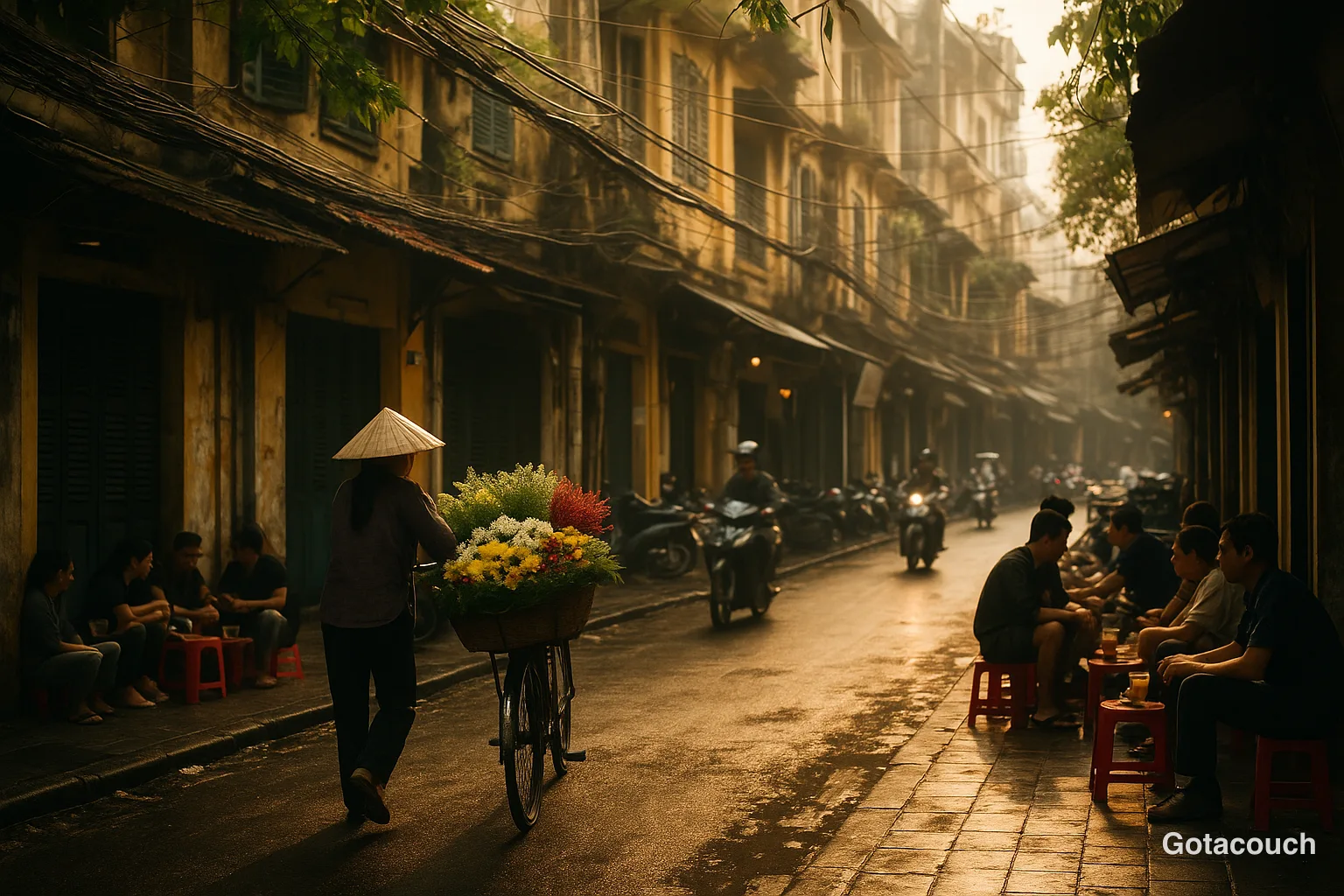
There are cities you visit, and there are cities you leaf through like an ancient manuscript, where each page has been written over the last without ever quite erasing what came before. Hanoi belongs to this second category. In a single morning, you can drink a coffee perched on a plastic stool in front of a centuries-old guild temple, walk past a colonial villa with peeling shutters, then find yourself beneath the ramparts of a World Heritage-listed imperial citadel. Nothing here is arranged for the visitor: everything coexists, jostles, interlocks. That is exactly what makes the Vietnamese capital so fascinating to discover from the inside, staying with locals, rather than through the window of a tour bus.
1010: The Day a King Saw a Golden Dragon
The city's official history begins in the autumn of 1010. King Ly Thai To decided to move his capital from Hoa Lu to Dai La and renamed the city Thang Long, "the rising dragon": according to legend, a golden dragon appeared above his royal boat at the moment it landed. Hanoi thus celebrated its millennium in 2010, an anniversary that triggered a wave of restorations and urban creations still visible today.
But the region was inhabited long before that. Under the Hung Vuong dynasty, the capital was located at Van Lang, and the future Thang Long was merely a rural village. In the 3rd century BCE, Thuc Phan — King An Duong Vuong — established the political and economic center of the kingdom of Au Lac at Co Loa, in what is now the outskirts of Hanoi. The site can still be visited today, and it is one of the finest off-the-beaten-path excursions for anyone with half a day and a scooter.
Then came the colonial layer, followed by the revolutionary one. It was at Ba Dinh Square that in September 1945 Ho Chi Minh proclaimed independence, and on October 10, 1954, that Hanoi was liberated — a date still celebrated every year, giving Hanoi's autumn a particular flavor.
The Old Quarter: "36 Streets" and a Good Dose of Symbolism
It's called Phố Cổ, the Old Quarter, or "the 36 old streets." It is the oldest continuously developing district in Vietnam: its street grid dates back nearly a thousand years and came alive as early as the 15th century, when artisan guilds organized themselves there by trade. Most streets still begin with the word Hàng, meaning "goods," followed by the product once sold there: Hàng Bạc, Silver Street; Hàng Mã, for paper offerings; Hàng Gai for silk; Hàng Duong for sugar.
The first detail that always amuses visitors: there are actually far more than 36 streets. The number is symbolic. It is thought to refer to the 36 original guilds — though some researchers believe it referred instead to 36 workshop locations in the 15th century, whose names were later transferred to the streets — or simply to the traditional Vietnamese way of saying "many."
The second detail is far more moving: each guild maintained one or two religious buildings dedicated to its patron saint or founder. As a result, every street in the Old Quarter houses at least one temple. Many have been absorbed into shops or homes, but their origins can still be glimpsed in the shape of their rooflines. Setting off on a hunt for temples hidden behind shopfronts, guided by someone from the neighborhood, remains one of the finest ways to spend a day in Hanoi.
Four Moods, Four Cities Within the City
- Hoan Kiem Lake: the pivot of the city, just south of the Old Quarter and within easy reach of the ancient citadel. On weekends, its surroundings become pedestrian-only and turn into a vast public playground — children on skates, dance circles, impromptu badminton games. This is where you come to understand Hanoians' very physical relationship with public space.
- The French Quarter: wide avenues, the Opera House, villas with shutters, the Metropole hotel. The absolute architectural counterpoint to the commercial maze.
- Ba Dinh: political and monumental Hanoi, where the Ho Chi Minh Mausoleum, the Imperial Citadel and the Temple of Literature can easily be combined into a single half-day — the temple is located at 58 Quoc Tu Giam Street, about ten minutes by car from Hoan Kiem Lake.
- Tay Ho: on the shores of West Lake, more spacious, more creative, slower-paced. The best place to catch your breath after three days immersed in the bustle of the center.
Practical note: since the administrative reform that took effect on July 1, 2025, Vietnam has merged its 63 provinces and municipalities into 34, eliminated the district level, and dissolved two-thirds of its communes and wards — with Hanoi recording the highest reduction rate in the country, over 77%. Names such as "Hoan Kiem District" or "Ba Dinh District" remain familiar reference points in everyday conversation, but they no longer carry official administrative status.
The Monuments That Actually Tell a Story
The Imperial Citadel of Thang Long
Inscribed as a UNESCO World Heritage Site on July 30, 2010 during the Brasilia session, the citadel's central sector was recognized for the length of its cultural history, its continuity as a seat of power, and the richness of its remains. UNESCO highlights more than 1,300 years of uninterrupted historical continuity. The archaeological site at 18 Hoang Dieu Street, west of the Kinh Thien Palace, belonged to the Forbidden City from the Ly dynasty through the end of the restored Le dynasty, and covers 47,720 square meters. Fifteen years after its inscription, the site remains as much a major center for archaeological research as a visitor destination.
The Temple of Literature
Founded in 1070 under Ly Thanh Tong to honor Confucius, it was completed six years later, in 1076, with the addition of the Quoc Tu Giam, the Imperial Academy — often described as Vietnam's first university. Initially reserved for princes, nobles and high officials, it opened in 1253, under Tran Thai Tong, to particularly gifted commoners' children. The complex spans roughly 54,000 square meters, is organized into five courtyards in different styles, and houses the Khue Van pavilion, the Well of Heavenly Clarity, and 82 stone stelae carried on the backs of stone turtles, engraved with the names of royal exam laureates. Students still come here to take photographs before their exams: this is no static museum.
Long Bien Bridge
Built by the French between 1899 and 1902 by the Parisian firm Daydé & Pillé, entirely of steel and 1,682 meters long, it was originally named after Governor-General Paul Doumer and was only renamed Long Bien in 1954. The first steel bridge to span the Red River, it still bears the scars of American bombing raids from 1967 to 1972. A persistent legend claims it as "the second longest bridge in the world after Brooklyn": best taken as a matter of local pride rather than established fact. Spanning some 2.3 kilometers, it is above all one of the rare peaceful walks at the heart of the city — best done at the end of the day, when the light skims across the urban rice paddies of the middle island.
The Red River Ceramic Mural
Created for the Thang Long millennium, it stretches 3,850 meters along the dyke, about 1.7 meters high, covering nearly 7,000 square meters — the Guinness World Record for the longest ceramic mosaic in the world. Launched in 2007 with support from the Hanoi People's Committee, the project brought together 35 professional artists from Vietnam and ten other countries, more than a hundred artisans from traditional ceramic villages, and 500 Vietnamese and foreign children. The idea came from Nguyen Thu Thuy, a journalist and artist, who wanted to turn a flood-prevention dyke system into a cultural landmark. It may well be the most democratic monument in the city.
What Gets Passed Down: Ca Trù, Puppets and Steaming Bowls
Hanoi's true intangible treasure is not the one most people expect. It is ca trù, a complex form of sung poetry from northern Vietnam, rooted in traditional poetic forms, inscribed in 2009 on the UNESCO List of Intangible Cultural Heritage in Need of Urgent Safeguarding. Attending a performance in a small house in the Old Quarter, just a few feet from a singer, a lute and a praise drum, leaves a far more lasting impression than any grand show.
The famous water puppets, meanwhile, deserve a clarification that many articles gloss over: contrary to what is often written, they are not inscribed on UNESCO's intangible heritage list. A scientific nomination file was still in preparation as of early 2026, led by the Hanoi People's Committee in coordination with the Ministry of Culture, Sports and Tourism — alongside a similar file dedicated to phở. This takes nothing away from the pleasure of the performance: it simply restores it to its rightful place, as a still very much alive village art form from the delta.
When it comes to food, Hanoi is eaten standing up, sitting low, or squatting. The morning bowl of phở, bún chả grilled over charcoal at midday, and above all cà phê trứng, that velvety egg coffee said to have been born during Hanoi's years of shortage, when fresh milk was scarce. Your hosts will each have their favorite spot, often a nameless stall tucked down an alley: this is precisely the kind of information no guidebook can replace.
A Capital on the Rise — and What That Means for You
According to the Hanoi Department of Tourism, the city welcomed more than 33.7 million visitors in 2025, up 20.8% year-on-year, including 7.82 million international visitors (+22.8%) and 25.9 million Vietnamese visitors (+20.3%). In other words, nearly three-quarters of the travelers exploring Hanoi are... Vietnamese. This is encouraging news: it means the city remains, above all, frequented by those who know it best. Tourism revenue is estimated at 134,460 billion dong, or roughly 5.3 billion dollars (+21.5%). For reference, the pre-pandemic record, set in 2019, stood at around 29 million visitors: that threshold has now been clearly surpassed. For 2026, the capital has set itself a target of more than 35.8 million visitors, including over 8.6 million international arrivals.
Nationally, the Vietnam National Administration of Tourism reports nearly 21.2 million international arrivals in 2025 (+20.4%), an all-time record, following 12.6 million in 2023 and 17.6 million in 2024. The country now ranks third among Southeast Asia's most visited destinations, behind Malaysia and Thailand. Hanoi, for its part, was honored at the World Travel Awards 2025 as "Asia's Leading City Destination" and "Asia's Leading City Break Destination," and ranks 2nd in TripAdvisor's list of the world's 25 best cultural destinations for 2025.
In practical terms, this means busier streets around Hoan Kiem Lake, the need to book ahead during high season... and an even stronger case for staying outside the strictly touristy perimeter, in a lived-in neighborhood such as Tay Ho, Truc Bach, or the areas around Ba Dinh.
When to Go, and How to Plan Your Trip
Autumn is Hanoians' own favorite season: the air turns milder, the light golden, and the city comes alive around the October 10 liberation anniversary. Spring is mild and festive, marked by pilgrimages to pagodas. Summer is hot, very humid, and punctuated by tropical downpours — not a dealbreaker, but it's best to plan sightseeing for early morning and late afternoon. Winter often surprises travelers: it doesn't freeze, but the humidity makes the days feel distinctly chilly, and indoor spaces are rarely heated.
A few pointers for a first stay:
- Three days minimum. One for the Old Quarter and the lake, one for Ba Dinh (citadel, Temple of Literature, mausoleum — it's worth checking opening hours and maintenance closure periods just before your visit, as they change regularly), and one for Tay Ho, Long Bien and the ceramic mural.
- Get the hang of the traffic. To cross a street in Hanoi, walk slowly and steadily, without running or stopping abruptly: the stream of motorbikes will flow around you and close back behind you. Watch how locals do it first.
- Eat early. Breakfast is the star meal; the best phở stalls are empty by 9 a.m. because they've sold out.
- Step outside the loop. Co Loa, the craft villages on the outskirts, a morning at a neighborhood market: this is where Hanoi stops being a postcard.
Staying With Locals, the Best Way In
Hanoi is a city of interiors. Its narrow "tube houses," a legacy of an old tax on building frontage width, stretch back deep across several floors, wrapped around light wells and steep staircases. You only discover them by invitation. Staying with a host means understanding why the ancestral altar occupies the top floor, learning what time the wandering bánh mì seller passes by, being shown the customs of tea, and having someone sketch out on a scrap of paper the route through a nameless alley.
In Hanoi, the real guided tour doesn't begin in front of a monument, but around a low table, at sidewalk height.
Ly Thai To's dragon still rises, in its own way: through one more construction site, a café opening inside a former silk shop, a young musician reviving his grandmother's ca trù. Come for the citadel and the 82 stelae; stay for the people who, without even realizing it, are writing the next layer.
Comments
Log in to leave a comment.
No comments yet.